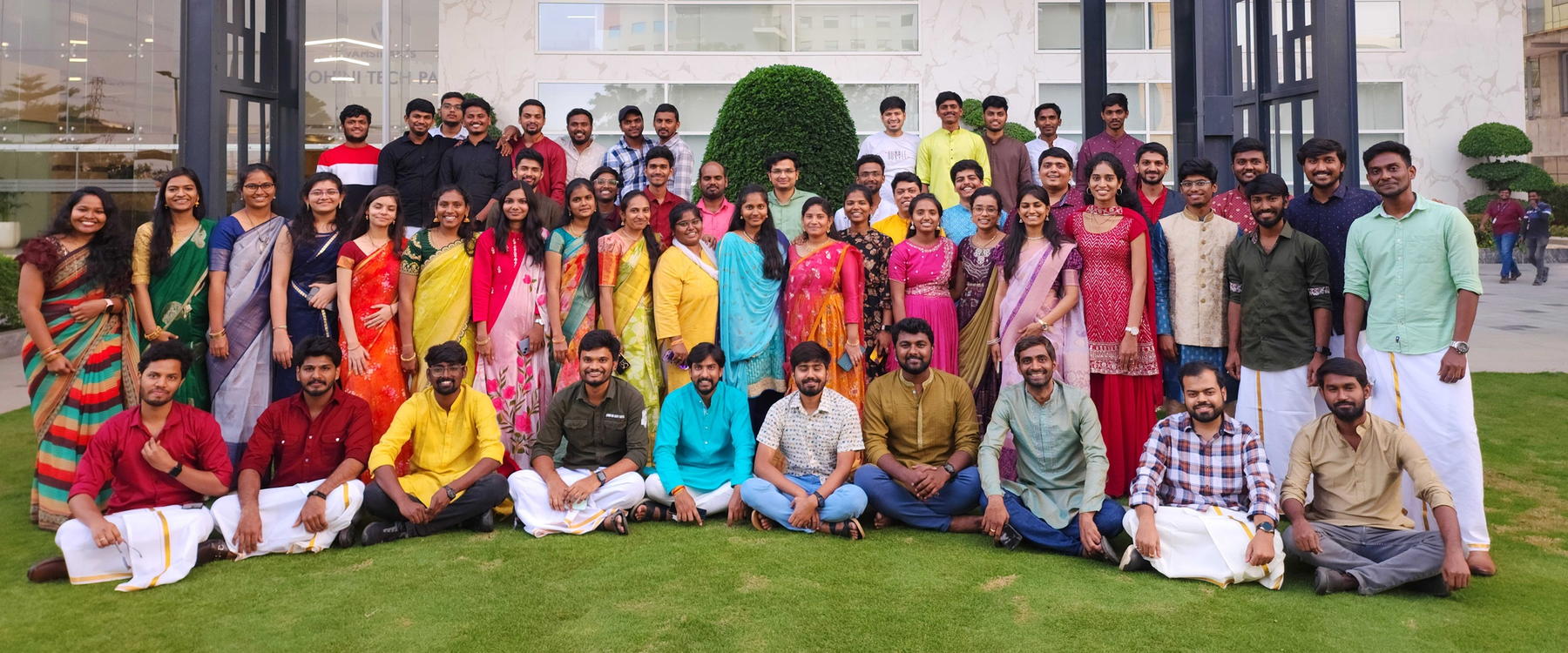
Founded at IIT Hyderabad in 2016. Radio, baseband, device stack and cellular IoT silicon, each layer designed in-house, then proven against the others.
Most vendors in this market integrate. They take a radio from one supplier, baseband from another, a device stack from a third, and spend their engineering effort making the seams hold. It is a legitimate business, and it constrains what you can invent.
We build our own layers: Navabeam, our 32TR ULPI radio, the distributed and central units, an end-to-end 3GPP Release 15 device stack, and NB-IoT silicon with non-terrestrial support. That is slower to start, and it is why ULPI exists. Moving uplink processing into the radio requires changing the radio, the fronthaul and the scheduler together, and that cannot be negotiated across three vendors’ roadmaps.
Owning the device side as well as the network side is the less obvious half. A device stack developed against our own base station surfaces interoperability problems during development rather than during an operator trial.
We do not build a core network. The base station works with whichever core the operator already runs.
Ten years from a signal-processing group at IIT Hyderabad to silicon, base stations and devices carrying live traffic.
Incorporated in July 2016 at the i-TIC Foundation to commercialise signal-processing research from the institute. First patent filings, and the beginning of a sustained contribution record at 3GPP.
The π/2-BPSK uplink waveform and NB-IoT coverage-enhancement work go into the 5G standard. Our founder is named in the first cohort of TSDSI Fellows. Work begins on the Government of India’s indigenous 5G testbed programme.
Koala, India’s first 5G system-on-chip for NB-IoT, and the first standards-compliant cellular modem designed in India rather than licensed in.
India’s first 5G data call over an indigenously developed Open RAN network. A 5G IoT chip combining design and manufacture in India. An Open RAN consortium agreement with C-DOT and VVDN. The platform is launched by the Prime Minister at India Mobile Congress 2022.
The first standalone 5G mmWave solution for the Indian market, demonstrated as backhaul at the G20 Digital Economy Working Group. The 5G patent portfolio is opened for licensing. C-DOT qualification of the disaggregated Open RAN platform continues.
An indigenous wireless system-on-chip launched. Next-generation O-RAN Massive MIMO with ULPI demonstrated with Altera at MWC 2025. Beyond-5G and 6G field demonstrations completed with Sharp SSIC and IIT Hyderabad.
The 32T32R Massive MIMO radio unit with ULPI unveiled at MWC Barcelona. Viasat begins live testing of the 5G satellite IoT chipset. IIT Hyderabad and WiSig research is carried into the 3GPP 6G study item.
Operator trials, private 5G deployments, interoperability testing or academic collaboration.