Founder and CEO of WiSig Networks, and Professor of Electrical Engineering at IIT Hyderabad.
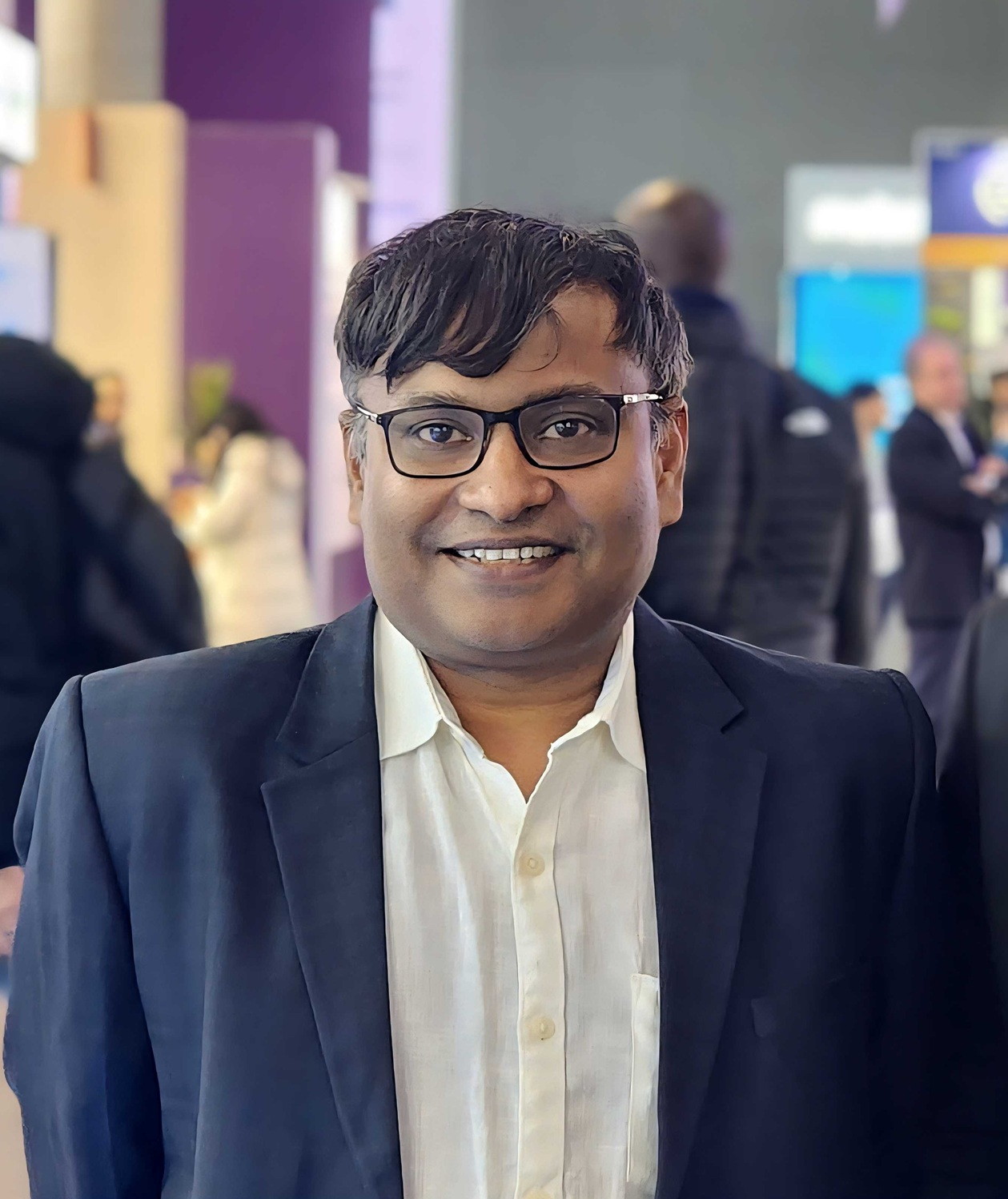
Kiran Kuchi founded WiSig Networks in 2016 at IIT Hyderabad, where he is a Professor of Electrical Engineering, to take the institute’s wireless research out of the lab and into equipment an operator can deploy.
He read Electronics and Communication Engineering at Sri Venkateswara University College of Engineering, Tirupati, and took his M.S. and Ph.D. in Electrical Engineering at the University of Texas at Arlington. The years in the United States went on the physical layer of each generation as it arrived: at Nokia his patents run from space-time codes and transmit diversity for 3G, through MIMO equalisation, to frame structure work in the LTE era. He holds more than two hundred international patents covering 2G through 5G.
At IIT Hyderabad he worked first on GSM, EDGE and 4G receivers, then led the institute’s part of the Government of India’s Indigenous 5G Testbed. His group became one of the country’s most active contributors to 3GPP, with well over 300 technical documents submitted, and among the technologies it introduced is π/2 BPSK with spectrum shaping, the uplink waveform that roughly doubles the transmit power available to handsets and IoT devices.
Elected to the fellowship of INAE, India’s national academy of engineering, with effect from 1 November 2025.
The Department of Telecommunications’ national telecom awards, run with COAI. India Mobile Congress marked the award for “his significant contributions to telecom technology”.
The Department of Telecommunications approved the programme in March 2018 at a cost of Rs 224 crore, across eight institutions; the Prime Minister dedicated the result to the nation on 17 May 2022. He led IIT Hyderabad’s part of it, which carries base station testing, user-equipment testing, end-to-end interoperability and NB-IoT testing.
Named first in the first cohort of TSDSI Fellows, “for his pioneering leadership at TSDSI and specifically for the Pi/2 BPSK and NB-IoT coverage enhancement contributions at 3GPP, thus establishing a firm global footprint for India as a technology innovator for 5G.”
The work began at IIT Hyderabad in 2014 and became the only new waveform adopted into 5G. A handset on OFDM transmits at a small fraction of what its amplifier is rated for, because the waveform’s peaks force the amplifier to be backed off; π/2-BPSK with spectrum shaping removes most of that penalty, which by IIT Hyderabad’s own account is three to four times the transmitted power and at least double the usable cell range.
Techniques that extend how far a narrowband IoT device can reach the network, which is what decides whether a meter in a basement or a sensor in a field is reachable at all. Cited by TSDSI alongside the waveform work, and carried on into Koala, the NB-IoT system-on-chip IIT Hyderabad and WiSig designed together, the first standards-compliant cellular modem designed in India.
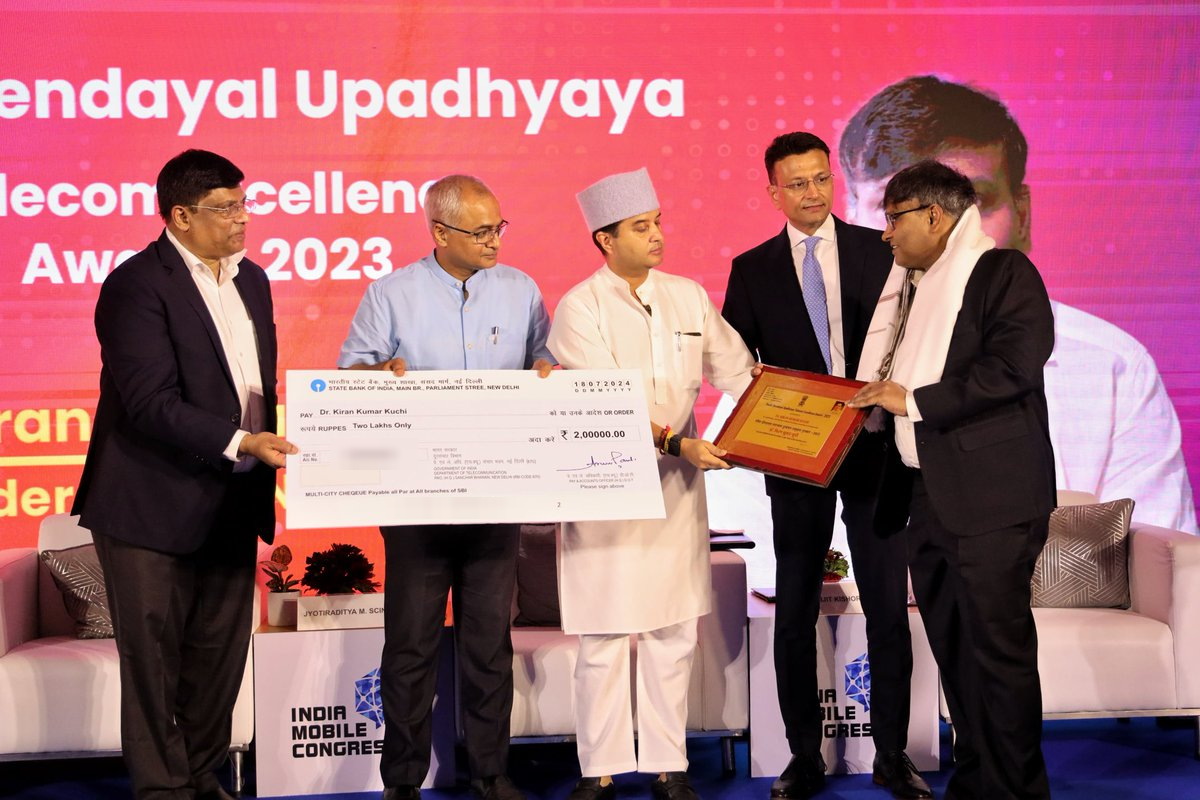
Receiving the Pandit Deendayal Upadhyay Telecom Excellence Award at India Mobile Congress.
Operator trials, private 5G deployments, interoperability testing or academic collaboration.