A complete 3GPP 5G NR user-equipment stack, from the physical layer to RRC and NAS, delivered as licensable IP that ports to your hardware.
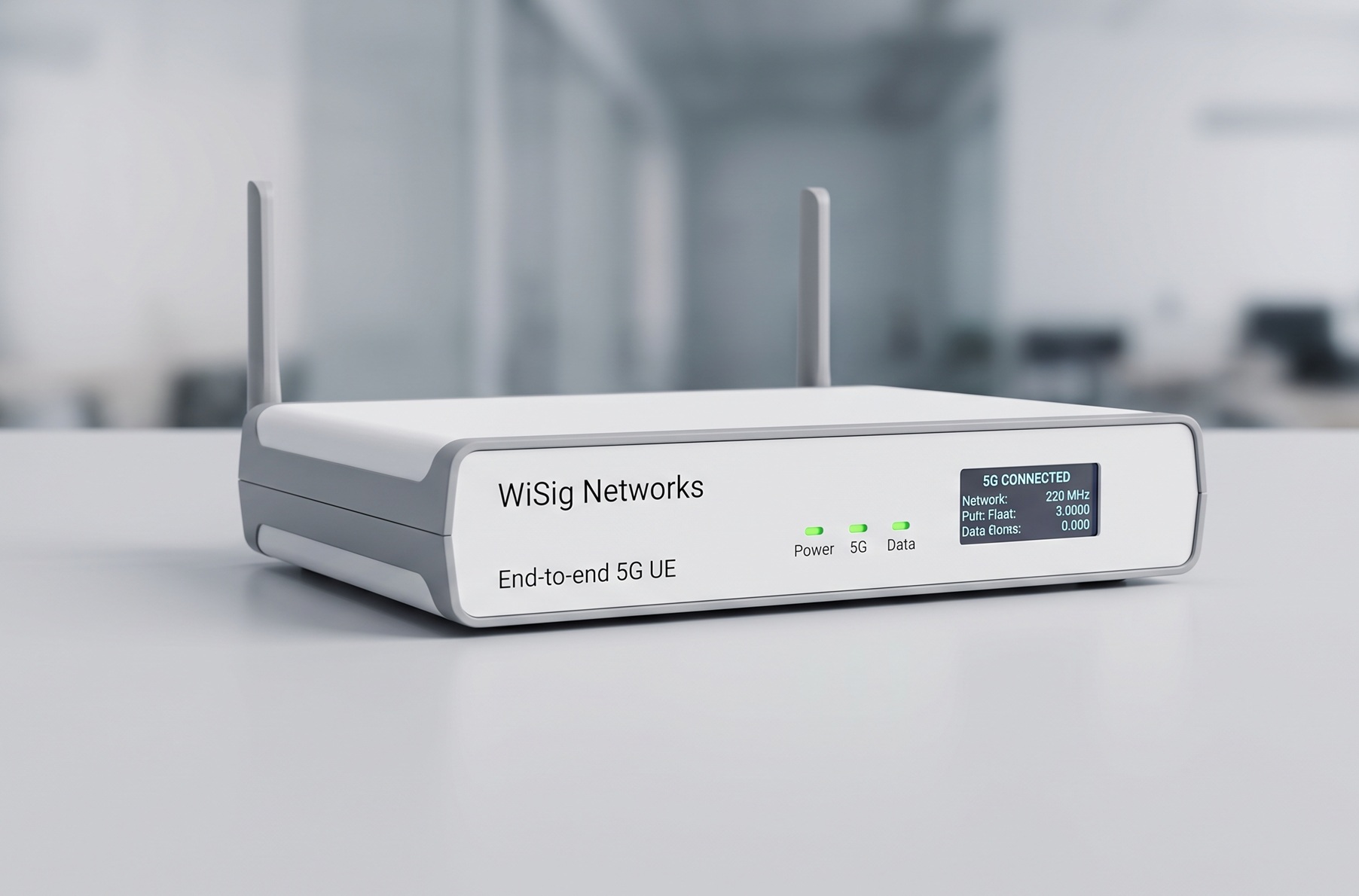
Select a photograph to see it larger.
A Release 17 NR user-equipment implementation for FR1 and FR2, shipping with the full L1, L2 and L3 protocol stack and the tooling engineers use daily: configuration, runtime control, live monitoring and protocol-level analysis.
It is delivered as source-level IP. That is the point of it: the stack ports to your own silicon or platform and integrates with your application, without a dependency on a third-party modem and without a black box in the middle of your product.
Building both ends of the link matters more than it sounds. A device stack developed against our own base station surfaces interoperability problems during development rather than during a trial. Every variant has been integrated and validated against multiple open-source and customer gNB platforms.
L1, L2 and L3 through to RRC and NAS, to 3GPP Release 17, developed in-house.
Delivered as source, so the stack ports to your own silicon with no third-party modem and no black box in the middle of your product.
Sub-6 GHz and millimetre wave from a single code base.
Standard, non-terrestrial and RedCap, sharing one core implementation.
JSON-templated configuration, multi-level logging and a graphical log analyser for protocol-level debugging.
Integrated and validated against multiple open-source and customer gNB platforms.
The same stack, configured for terrestrial, satellite or reduced-capability devices. Peak throughput figures are from the product brochure.
The full stack: complete Release 17 NR procedures, mobility management, carrier aggregation, MIMO, bandwidth parts, HARQ and beam management, with a graphical log analyser for protocol debugging.
1200 Mbps down · 400 Mbps upFR2, 400 MHz
Adds GNSS-based delay and Doppler pre-compensation, satellite switching without dropping the session, HARQ adapted to long round trips, enhanced PRACH, epoch time synchronisation and differential K-offset. Terrestrial FR1 and FR2 operation is unaffected.
800 Mbps down · 890 Mbps upFR2, 200 MHz
Trimmed for devices that need 5G without full bandwidth: reduced complexity, lower power, small data transmission, extended DRX and relaxed RRM measurements. Built for industrial sensors, wearables, cameras and IoT gateways.
65 Mbps down · 20 Mbps upFR1, 20 MHz
| Release | 3GPP Release 17 |
|---|---|
| Variants | 5G NR UE · NTN UE · RedCap UE |
| Frequency ranges | FR1 and FR2 from one code base |
| Protocol coverage | PHY, MAC, RLC, PDCP, RRC, NAS and SDAP |
| NR features | MIMO, bandwidth parts, HARQ, scheduling, beam management |
| Carrier aggregation | Multiple NR component carriers |
| Mobility | Measurements, handover and connected-mode procedures |
| Tooling | JSON configuration, multi-level logging, graphical log analyser |
| Delivery | Source-level IP, portable to customer silicon |
| Interoperability | Validated against open-source and customer gNB platforms |
Operator trials, private 5G deployments, interoperability testing or academic collaboration.