Upcoming India Mobile Congress 2026 · 7–10 October 2026 · New Delhi · Hall 2 · Stand D33–34 and D38–39 Event details
Contact us

ULPI : Advanced Uplink Processing inside Radio Unit

ULPI moves channel estimation and beamforming from the O-DU into the O-RU. This allows the radio to use live multi-antenna channel information locally, improving cell-edge performance, uplink throughput and coverage efficiency. This enables operators to extend usable cell radius and provide better end user experience.

The uplink sets the cell radius, not the downlink

Coverage planning tends to be discussed in terms of what the base station transmits. In practice it is the handset that sets the usable cell radius. A base station transmits tens of watts per port. A commercial handset manages a fraction of a watt.

The result is a coverage hole that does not show up on a signal-strength map. A user at the cell edge sees full bars and cannot hold a video call, because their device cannot get a clean signal back. In rural deployments, where cells are large by necessity, this is a limiting factor on how far a site can usefully reach.

The conventional answer is to build more sites. That is expensive.

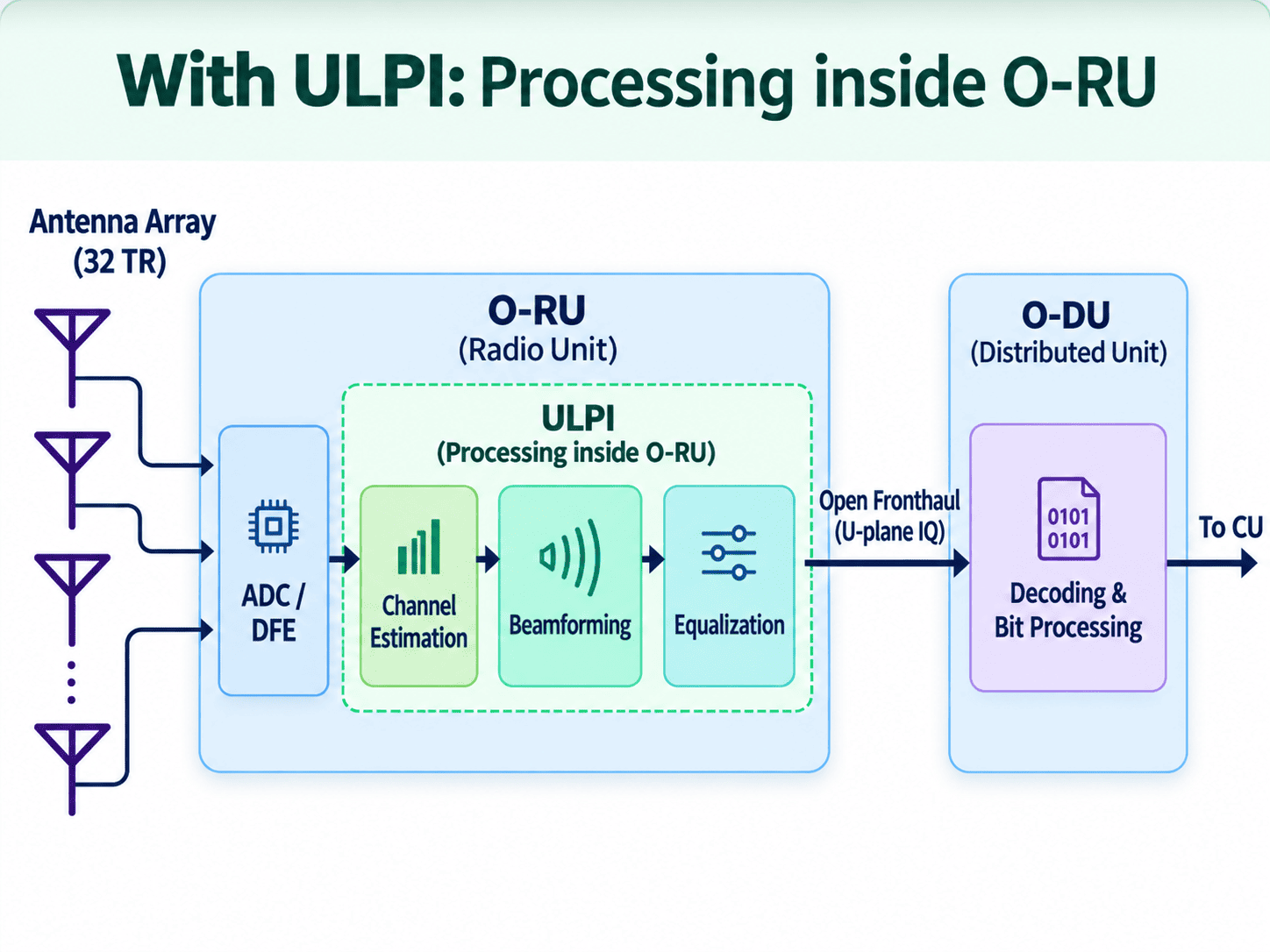
ULPI mitigates these factors by utilising more recent channel information from all 32 receive antennas.

Diagram: with ULPI, the O-RU does channel estimation, beamforming and equalisation on the 32 receive antennas, and the open fronthaul carries uplink layers to the O-DU for decoding

ULPI Overview

ULPI does the difficult part in the radio unit itself which enables use of latest and superior channel information.

01

Estimation in the radio

Channel estimation runs on the demodulation reference signals inside the O-RU, using all thirty-two receive paths at full fidelity.

02

Combining before transport

For single layer up link recpetion, full beamforming gain is achieved thereby improving range or performance of cell edge users.

03

Equalise before transport

For multi-layer and MU-MIMO reception, more recent 32 antenna channel estimates help improve spatial separation of concurrent users’ data while maximising available diversity and array gain. WiSig algorithms provide superior equalisation performance.

Two ULPI classes

Class A and Class B share the same efficient layer-based fronthaul principle: both transport the configured number of uplink layers. The key distinction is DMRS transport optional in Class A and mandatory in Class B. WiSig ULPI supports both, allowing operators to choose the processing architecture that best fits their network without constraints.

Baseline · Conventional 7.2x

Processing centred at the O-DU

Per-antenna frequency-domain IQ is transported to the baseband.

O-RU · In the radio
RF, CP removal, FFT
Fronthaul carries

Per-antenna frequency-domain IQ across the receive paths.

O-DU · At the baseband
Channel estimation
Receive beamforming
Equalisation
Demodulation and decoding
Reference architecture Centralised uplink processing, with greater fronthaul transport than the layer-based ULPI profiles shown alongside.
WiSig ULPI · DMRS-BF-EQ

Equalisation inside the radio

Beamforming and equalisation are completed in the O-RU.

O-RU · In the radio
RF, CP removal, FFT
Channel estimation using DMRS
Receive beamforming + equalisation
Fronthaul carries

Configured uplink layers, with DMRS transported optionally when required.

O-DU · At the baseband
Demodulation and decoding
WiSig support · Fully supported More uplink processing stays in the radio, reducing fronthaul transport while retaining the layer-based interface.
WiSig ULPI DMRS-BF-NEQ

Beamforming in the radio. Equalisation at the O-DU.

The O-RU reduces antenna-domain data while preserving DMRS at the baseband.

O-RU · In the radio
RF, CP removal, FFT
Channel estimation using DMRS
Receive beamforming
Fronthaul carries

Configured uplink layers together with mandatory DMRS.

O-DU · At the baseband
Equalisation
Demodulation and decoding
WiSig support · Fully supported Equalisation remains at the O-DU, preserving the reference information required for O-DU-side processing and coordination.

Inside the radio unit

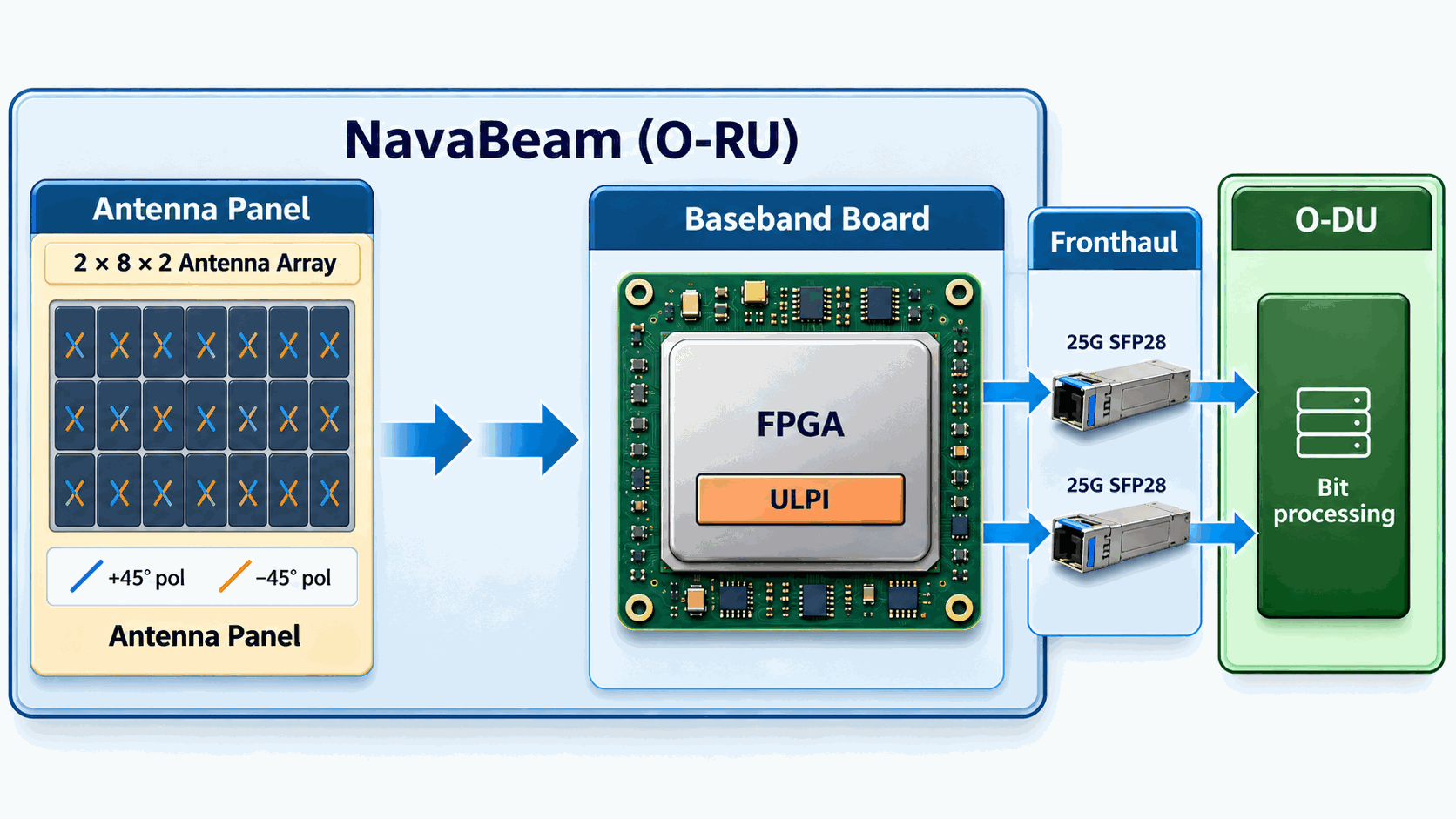
A conventional radio unit mainly converts and forwards uplink signals to the O-DU. In WiSig’s Navabeam O-RU, ULPI is integrated, bringing channel estimation and beamforming into the radio before the data crosses the fronthaul. The architecture is shown below.

Block diagram of the Navabeam radio unit: antenna panel, baseband board carrying ULPI on the FPGA, and the two 25G SFP28 fronthaul links to the O-DU

Enquiries and technical briefings

Operator trials, private 5G deployments, interoperability testing or academic collaboration.

Contact us