The standard that follows 5G is in its study phase. Three pieces of what we build are inside it: a waveform, an antenna architecture and an extension of the uplink modulation already in 5G. The platform they run on is meant to reach the new release by software upgrade rather than by replacement.
6G is being specified in two places at once. ITU-R Working Party 5D sets the requirements, under the name IMT-2030. 3GPP writes the specification that equipment is built to, and opened its 6G study item in 2025.
India reaches both through TSDSI, its telecommunications standards body, where our founder sits. The group at IIT Hyderabad he came from is among the country’s most active contributors to 3GPP.
Getting a technology into a standard is not a matter of publishing a better idea. It has to be proposed, evaluated against the incumbent, and then supported by enough of the industry to survive the vote. That is the work.
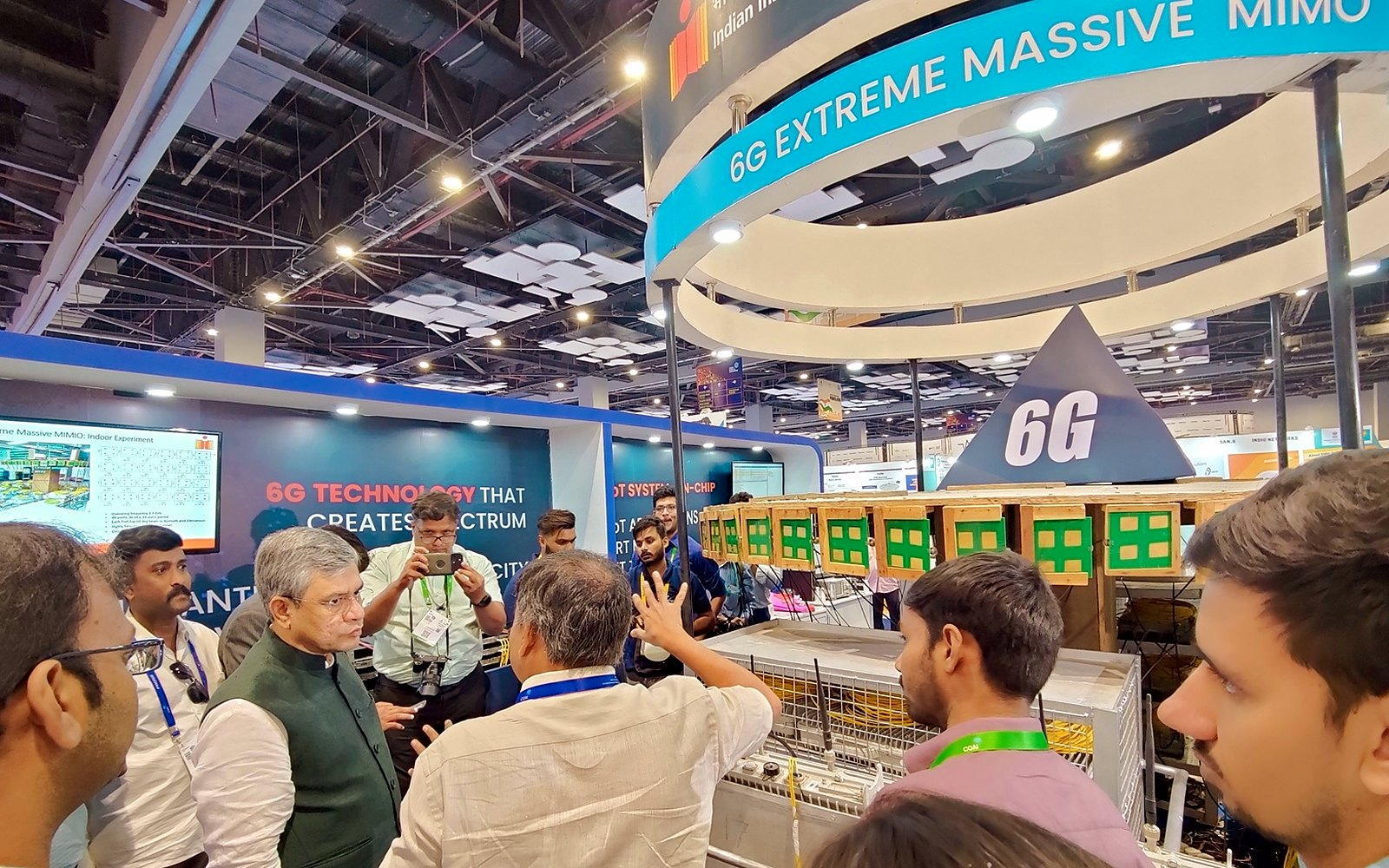
Three lines of work, each aimed at a different limit in the radio link.
Reference signal and data inside one symbol, so a transmission is complete in a single symbol period and the channel estimate never has to be interpolated across a slot. It cuts reference overhead from a fixed 28.6 per cent to between 4.9 and 13.5 per cent. The detail is on its own page.
Panels arranged around a structure rather than on one face, so a site covers the full 360 degrees in azimuth and in elevation from a single installation. Published analysis puts the combined figure for OTFDM and structural MIMO at up to 116 bits per second per hertz, against 21 for 5G.
Frequency Range 3, the band between today’s sub-6 GHz and millimetre wave, is where the capacity-against-coverage trade-off for 6G has to be settled. Amplifier efficiency falls away up there, which is exactly the problem a low peak-to-average waveform exists to solve.
At 3GPP TSG RAN #108 a consortium proposed extending the π/2-BPSK uplink waveform, the India-origin modulation already in 5G, for the uplink-heavy services 6G is expected to carry: high-definition video, immersive XR, and inference running on the device. OTFDM and structural MIMO were advanced within the newly approved 6G study item at the same meeting.
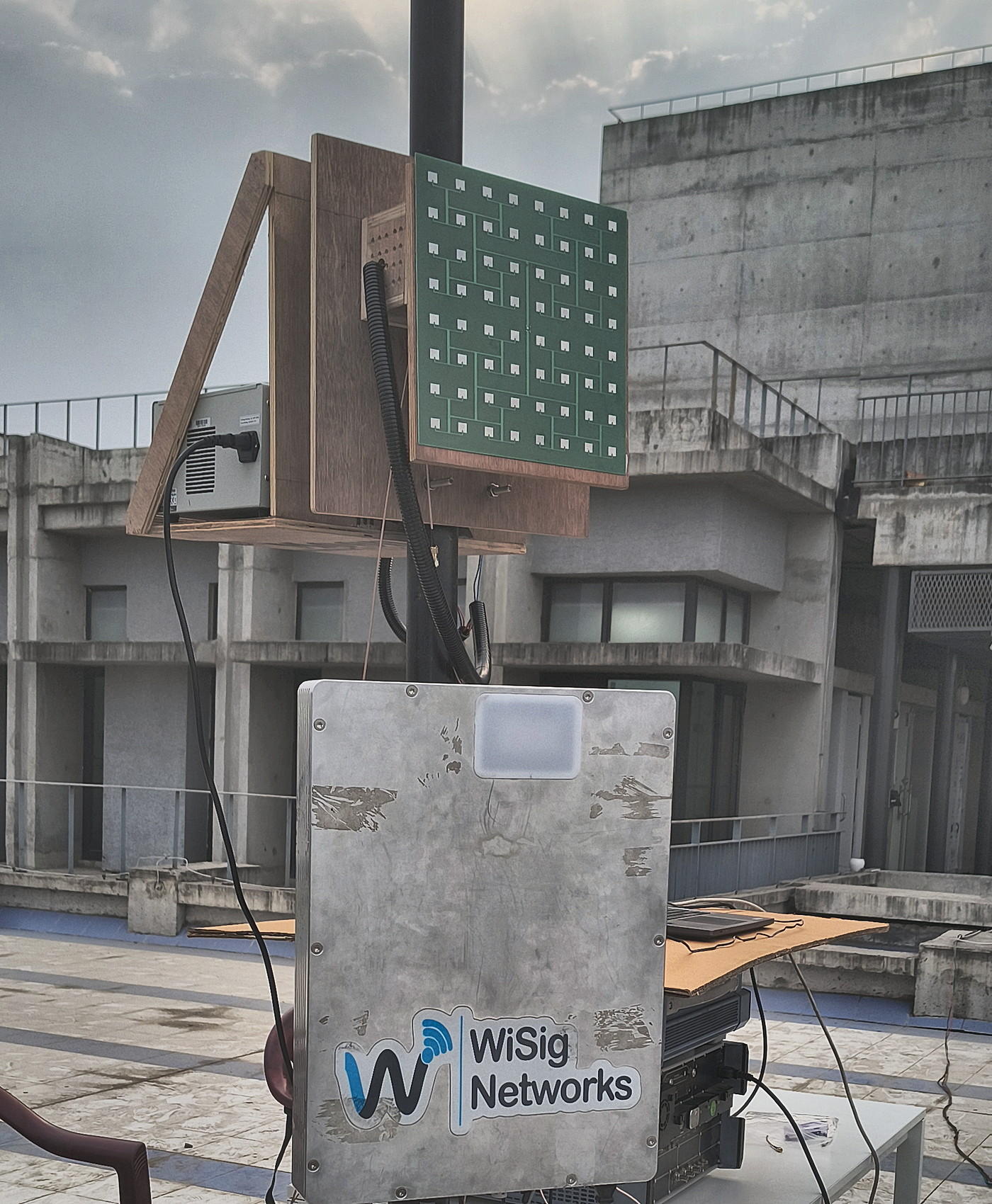
A waveform argued for in a standards meeting has to be shown working. In May 2025, with Sharp Semiconductor Innovation and IIT Hyderabad, we ran beyond-5G and 6G field trials on the IIT Hyderabad campus: their ASUKA software-defined-radio system-on-chip against our Open RAN base stations and user equipment.
The announcement reports connectivity and performance comparable to commercial 5G silicon, with fixed wireless access, mission-critical push-to-talk, vehicle-to-everything and satellite-capable NB-IoT metering named as the cases the partnership is aimed at.
The same rooftop carries the OTFDM demonstration: a patch antenna array on a bracket, a radio unit on the mast below, and a waveform that does not exist in any standard yet.
The platform is designed so that the 6G release is reached by software upgrade rather than replacement. That is a deliberate constraint on the research: a proposal that cannot run on the radio we already ship is a proposal we have to argue for twice.
The waveform, the antenna architecture and the uplink modulation extension we are taking into the 3GPP study item, what each is meant to solve, and where the work stands. Tell us where to send it and it comes by email.
Operator trials, private 5G deployments, interoperability testing or academic collaboration.